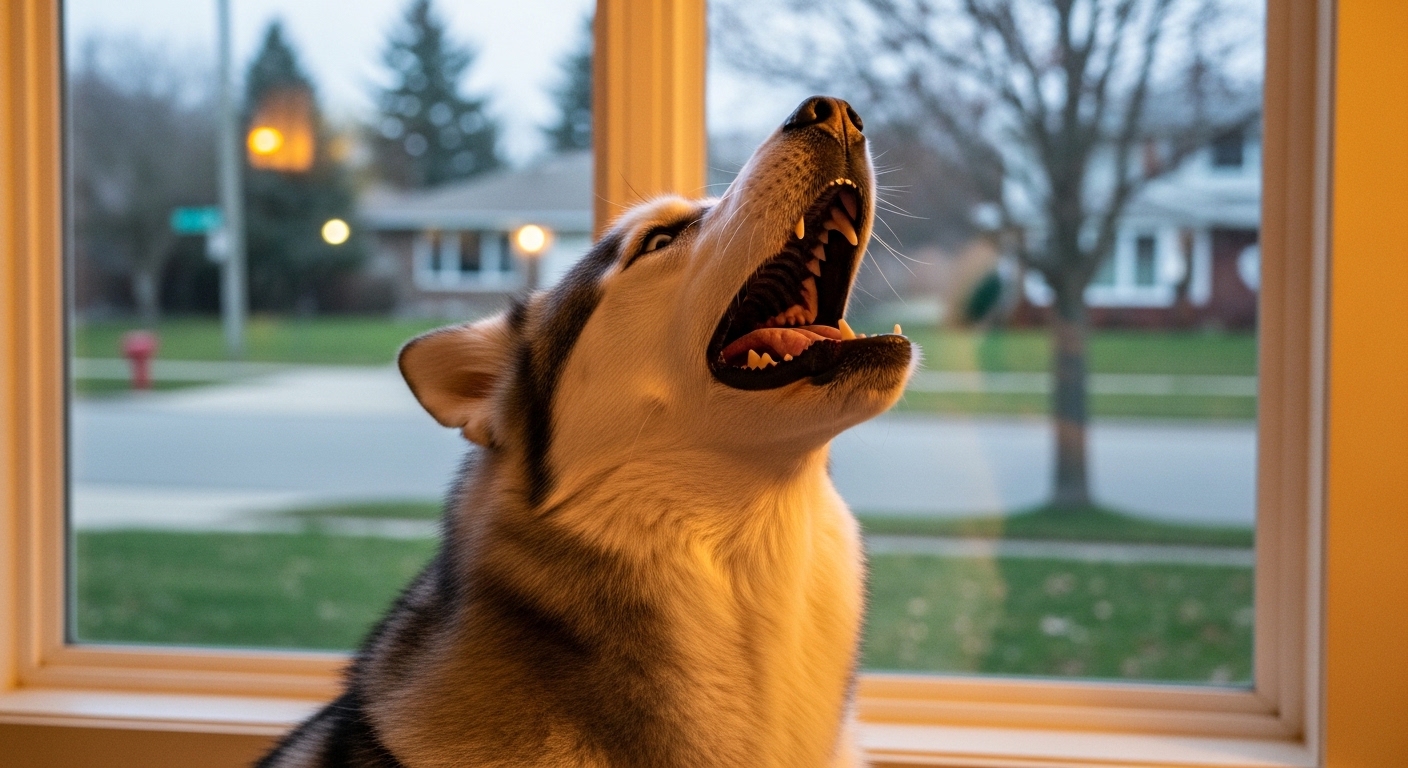
You are sitting quietly on the couch when a fire truck rumbles past outside. Within seconds, your dog throws their head back and lets out a long, mournful howl — completely unprompted, totally committed, and honestly a little dramatic. If you have lived with a dog for any length of time, you have almost certainly witnessed this. It happens so reliably that many owners start to wonder whether something is actually wrong, or whether their dog is just... being a dog. The short answer is the latter, but the full picture is more interesting than that.
Why It Happens: Instinct, Frequency, and the Pack Brain
Dogs hear frequencies humans cannot. Their upper hearing range extends to roughly 65,000 Hz, compared to our ceiling of around 20,000 Hz. Emergency sirens are designed to cut through noise — they sweep through a range of tones that, to a dog, may land in a register that feels impossible to ignore. Think of it less like a sound your dog chooses to respond to, and more like a reflex that gets triggered before conscious thought enters the picture.
But frequency alone does not explain the howl. The behavior is deeply rooted in pack communication. Wild canids — wolves, coyotes, and their relatives — use howling to locate pack members across long distances, to signal their position, and to coordinate group movement. When your dog hears what sounds like a sustained, rising call from somewhere out in the world, some part of their brain interprets it as a distant signal that deserves a reply. They are not distressed. They are answering.
Research in canine behavior suggests that howling is also socially contagious within groups. If one dog starts, others nearby often join in — which is why multi-dog households can turn a single passing ambulance into a full neighborhood choir. The behavior is communicative, not panicked, even if it sounds alarming to human ears.
Dogs do not howl at sirens because they are in pain. In most cases, they are doing exactly what their ancestors were built to do: respond to a long-distance call.

Step-by-Step: Training Your Dog to Stay Quiet at Sirens
If the howling is occasional and brief, most owners learn to live with it — sometimes even find it endearing. But if you live near a fire station, or your dog's response goes on for several minutes after the siren fades, a bit of training can help. The goal is not to punish the instinct, but to give your dog an alternative behavior to default to.
- Identify the trigger clearly. Confirm it is specifically sirens causing the howling, not general outdoor noise. Play siren sounds at low volume on your phone to test the response in a controlled setting.
- Introduce a 'quiet' cue before the behavior escalates. The moment your dog begins to howl, calmly say 'quiet' in a neutral tone — not sharp or punishing. Wait for even a two-second pause.
- Mark and reward the silence immediately. The instant your dog stops howling, mark it with a clicker or a short verbal marker like 'yes,' and follow with a high-value treat. Timing matters more than anything else here.
- Practice with recorded siren sounds. Gradually increase the volume over multiple sessions. This desensitization approach helps your dog learn that the sound is not something requiring a vocal response.
- Build duration gradually. Start rewarding two seconds of quiet, then five, then ten. Do not rush this — dogs learn duration in small increments, and pushing too fast usually means starting over.
- Generalize to real sirens. Once your dog responds reliably to recordings, real sirens will still be unpredictable in timing, but the conditioned response should begin to transfer over several weeks of consistent reinforcement.
Consistency matters more than intensity here. Five calm, focused two-minute sessions across a week will outperform one frustrated thirty-minute attempt every time.

Common Mistakes Owners Make
The most common error is reacting emotionally. When a dog howls, many owners laugh, mimic the howl back, or make a fuss — all of which the dog reads as social reinforcement. You have just told them that howling gets a fun response from the pack leader. Expect more howling.
Shouting 'no' or 'stop' rarely works either. To a dog mid-howl, a loud human voice can actually sound like joining in. Calm and neutral is the register you want, not frustrated and loud.
A few other patterns worth avoiding:
- Punishing the dog after the howling has already stopped — the connection between behavior and consequence is gone within a few seconds.
- Expecting the behavior to disappear after one or two training sessions — siren-howling is deeply instinctive and takes consistent work over weeks.
- Using aversive tools like spray bottles or shock collars, which may suppress the behavior temporarily but can create anxiety around the sound itself.
- Ignoring the behavior entirely if the dog seems genuinely distressed — howling paired with pacing, panting, or destructive behavior may signal something beyond a simple instinct response.

Expert Tips That Actually Help
Trainers who work with reactive dogs often suggest pairing the siren sound with something your dog loves before any howling starts. If you hear a distant siren approaching, immediately scatter a few treats on the floor or produce a favorite toy. You are creating a new association: siren equals good things appear, not siren equals time to sing. Over time, many dogs will actually look to you expectantly when they hear a siren, rather than launching into a howl.
Environmental management is underrated. Keeping background noise on — a TV, a fan, or a white noise machine — can reduce the sharpness of distant sirens enough that some dogs simply do not register them as clearly. This is not a training solution, but it is a practical one for households near busy emergency routes. One owner I know runs a box fan in the hallway specifically because her beagle mix would otherwise lose his mind every time the station three blocks away dispatched a truck. It is not glamorous, but it works.
Physical exercise before peak siren hours (typically morning and evening rush times in urban areas) can also reduce the intensity of the response. A tired dog has less arousal to throw at a passing ambulance.

When to See a Professional
Most siren-howling is completely normal and does not require professional intervention. But there are situations where consulting a certified trainer or your veterinarian makes sense.
If the howling is accompanied by signs of genuine distress — trembling, excessive drooling, destructive behavior, or an inability to settle for a long period after the siren has passed — that pattern may point toward noise sensitivity or anxiety that goes beyond a simple instinct response. Many vets suggest that noise-related anxiety in dogs exists on a spectrum, and some cases may benefit from behavioral support or, in more severe situations, a conversation about whether additional help is appropriate. Always consult your veterinarian if you suspect anxiety is a factor.
A certified professional dog trainer (CPDT-KA) or a veterinary behaviorist can assess whether what you are seeing is normal communication behavior or something that warrants a more structured intervention plan.
Frequently Asked Questions
Does howling at sirens mean my dog is in pain?
In most cases, no. The howl triggered by a siren is a communicative response rooted in instinct, not a sign of physical discomfort. Dogs that are in pain typically show other signs alongside vocalization — reluctance to move, changes in posture, or sensitivity to touch. If you are unsure, consult your veterinarian to rule out any underlying issues.
Why do some dogs howl at sirens and others do not?
Individual variation plays a significant role. Breed tendencies matter — hounds and northern breeds like huskies and malamutes are generally more vocal and may be more prone to siren-howling. But individual temperament, early socialization, and even how much attention a dog received the first time they howled can all shape whether the behavior becomes a habit.
Should I try to stop my dog from howling at sirens?
That depends on how disruptive it is. Occasional, brief howling is harmless and does not need correcting. If the behavior is prolonged, happens at night, or causes stress in your household, working on a 'quiet' cue is a reasonable and achievable goal. There is no harm in letting a dog express a natural behavior in moderation — the key word being moderation.
Siren-howling is one of those behaviors that reminds you how much dog is still in your dog, regardless of how many years they have spent sleeping on your bed and begging for pasta. It is instinctive, mostly harmless, and usually manageable with a bit of patient training. If it bothers you, you can work on it. If it does not, you can also just let them have their moment and move on with your evening.

Comments
Post a Comment